
Fintech
Find and Fix Hidden Tax Errors in Your Books: Detecting Stale Rates, Out‑of‑Province PST, and Misposted Tax Lines
Introduction
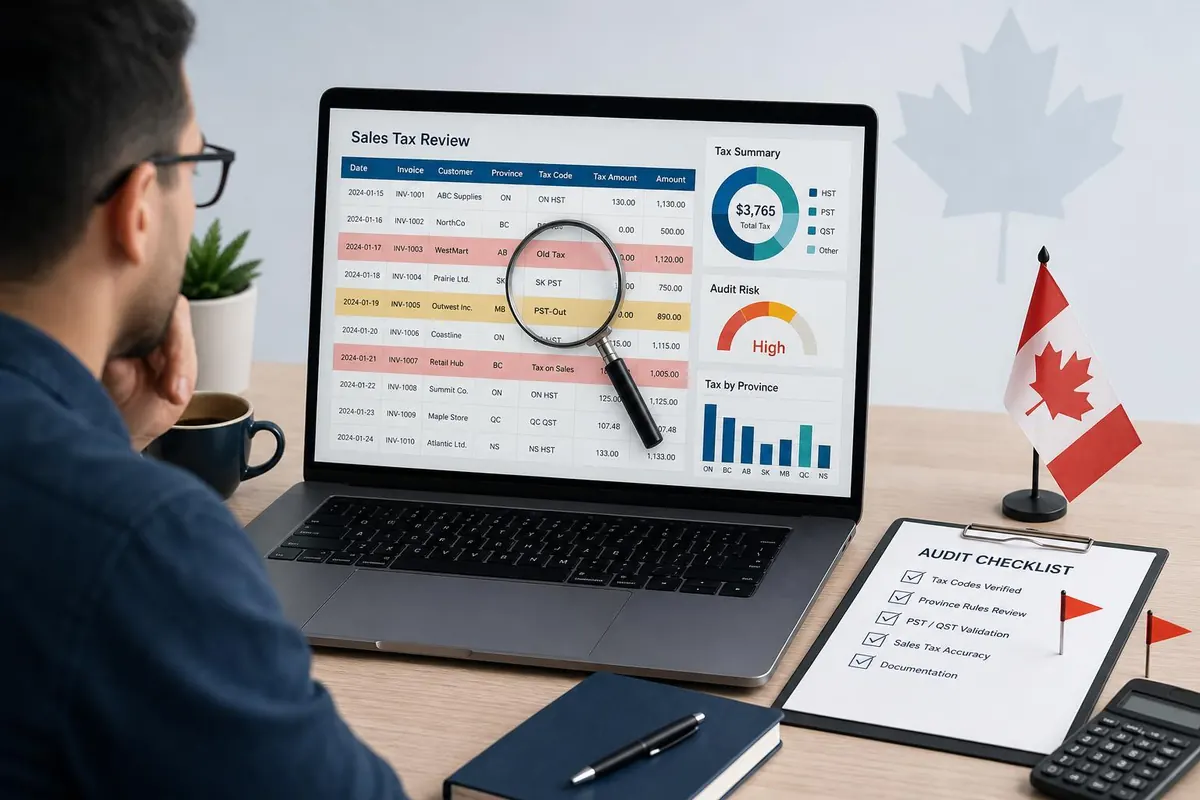
If you run a small business in British Columbia, your accounting records do more than show sales and expenses. They determine what you remit to the Canada Revenue Agency and the BC Ministry of Finance. Three common problems show up in bookkeeping reviews: old or incorrect tax rates still applied to sales, charging BC provincial sales tax (PST) to customers who are outside the province, and tax amounts booked to a sales account instead of a tax liability account. These errors can inflate revenue, distort margins, and trigger remittance issues or audits. This article walks you through how to find these issues in your records, how to correct entries, and practical controls to prevent recurrence, with examples in Canadian dollars.
Detecting where problems show up
Start with targeted reports from your accounting software (QuickBooks Online, Xero, Sage, etc.). Run these reports for a reasonable review period—usually the last 12 to 36 months depending on how long you suspect the issue has existed:
- Sales by tax code — lists invoices grouped by tax code to spot invoices still using obsolete codes.
- Tax liability report — shows GST and PST collected and payable; compare to remittances filed.
- Sales by customer province — identifies transactions shipped or billed outside BC that still have PST applied.
- General ledger for sales accounts — look for unusual credits labeled “PST” or “GST” inside sales revenue accounts.
Cross-check invoices with shipping records and customer addresses. For PST questions, gather evidence of out-of-province delivery such as courier tracking numbers, signed delivery receipts, and contracts showing place of supply. If your software stores tax rates by date, filter for older tax codes or legacy HST/PST combinations that may have remained active.
Common causes, examples and quick fixes
Below are typical root causes with practical fixes and a short example to make corrections easier to implement.
| Problem | Cause | Quick fix | Example |
|---|---|---|---|
| Old tax rate still in use | Legacy tax code left active after tax regime changes | Update tax code in software, reclassify historic invoices if material | Invoice $1,000 charged at wrong 8% PST. Correct rate is 7%. Adjust tax of $80 to $70; create a $10 credit note or make an adjusting journal entry. |
| PST charged to out‑of‑province customer | Address or shipping location not validated; user error | Issue credit for PST, document export proof, update customer records | Sale $2,000 to Alberta charged PST $140. Void or credit PST $140 and keep shipping proof to support not remitting PST. |
| Tax booked to a sales account | Manual posting error or incorrect mapping in import | Move tax amount from revenue to tax payable via journal entry | Sale $1,000 with PST $70 posted to Sales. Journal: debit Sales $70; credit PST payable $70. |
How to correct entries and update your systems
Take a stepwise approach to corrections so your ledgers remain auditable.
- Quantify the scope. Use reports to total errors by year and tax type. Determine which corrections are material to financial statements and tax filings.
- Fix the bookkeeping. For errors where tax was posted to revenue, record a correcting journal entry. Example journal to move PST from sales to liability:
Debit Sales (revenue) $70
Credit PST payable (liability) $70
For invoices that incorrectly charged tax to an out-of-province customer, create a credit note for the tax portion and reissue the invoice without PST, or provide a tax-only credit and retain proof of shipment.
- Adjust tax returns where required. If tax already remitted is incorrect, prepare amended PST or GST returns for the periods affected. File amendments promptly and attach reconciliation workpapers. Small businesses often contact the BC Ministry of Finance or CRA for guidance on remittances and possible waivers for administrative penalties if corrections are made proactively.
- Update tax codes and mappings. Change tax rate settings in your accounting software, and review item and customer tax code defaults. Lock or archive legacy codes so they cannot be used accidentally.
- Document everything. Keep copies of credit notes, amended returns, shipping proofs, and internal memos describing the corrections. Good documentation reduces audit risk.
Preventive controls and compliance checklist
After corrections, reduce the chance of repeat errors by implementing simple controls:
- Validate customer province and shipping address at the point of sale. Require postal codes for online checkouts and enable address verification.
- Configure software to prevent legacy tax codes from being selectable and set default tax codes by product and customer location.
- Reconcile tax payable accounts monthly, not just at year end. Compare your tax liability ledger to tax returns filed and bank remittances.
- Train staff on tax rules: PST applies to goods and certain services consumed in BC; goods shipped out of BC typically are not subject to PST when supported by proof of export.
- Schedule an annual internal audit: review a sample of invoices across customers and provinces, and confirm tax treatment is correct.
If the dollar amounts or the number of affected transactions are large, bring in a tax professional experienced in BC PST and GST/HST to help prepare amended returns and negotiate any penalties or interest.
Conclusion
Inspecting your accounting data for outdated tax rates, PST charged to out‑of‑province sales, and tax amounts booked to sales accounts is essential for small businesses in British Columbia. Start by running targeted reports, cross-check invoices with shipping records, and quantify how widespread the errors are. Correct the bookkeeping with journal entries and credit notes, amend tax returns where necessary, and gather supporting documents to reduce audit risk. Finally, lock legacy tax codes, validate customer location at point of sale, and reconcile tax payable monthly to prevent recurrence. Taking these steps now will reduce the chance of unexpected tax bills, preserve your margins, and keep your books accurate and audit-ready.