
Automation
Keeping Inventory in Sync: How Stores, Warehouse and Online Share One Real-Time Number
Introduction
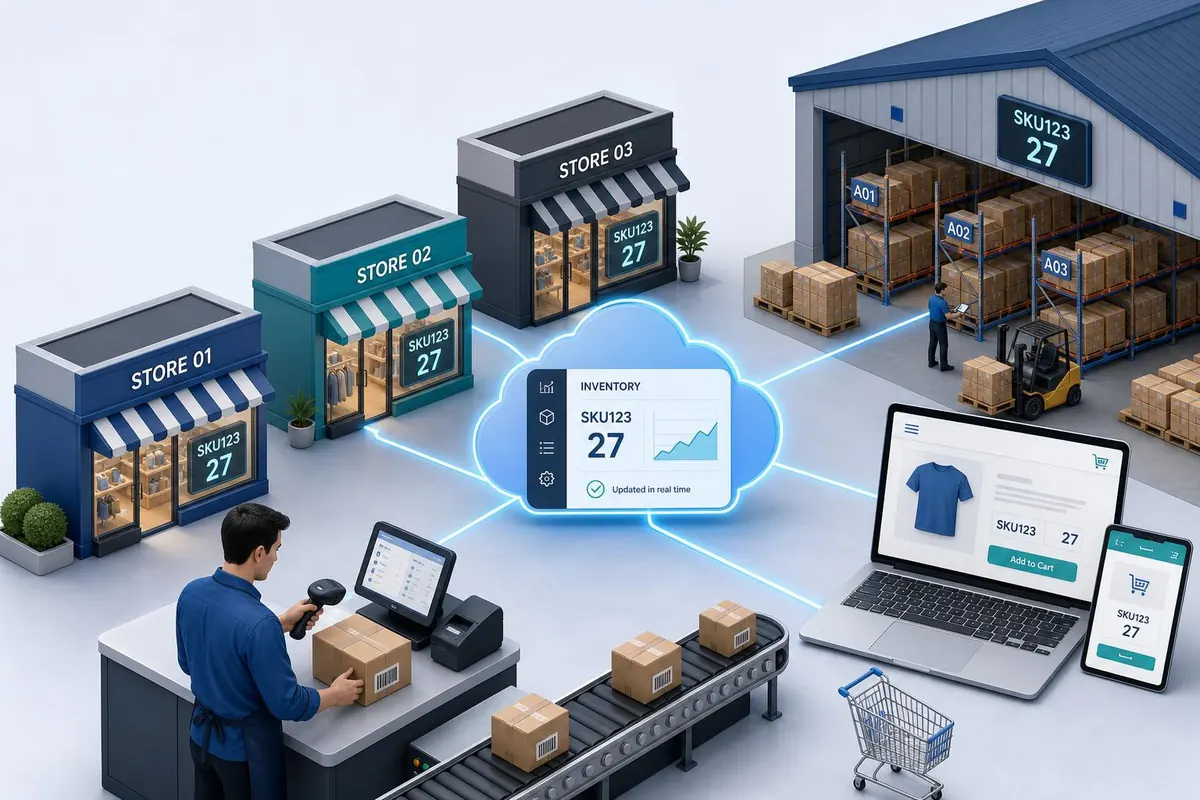
Managing inventory across multiple retail outlets, a central warehouse, and an online store is one of the biggest operational challenges for small businesses in British Columbia. When store staff, warehouse pickers, and e-commerce customers all need visibility of the same stock, discrepancies create lost sales, wasted labour, and unhappy customers. This article explains how to make every sales channel "read" the same number: the principles of a single source of truth, the architecture that supports real-time sync, operational routines that keep counts accurate, and how to budget for practical tools. The aim is to give BC small business owners clear, implementable steps that reduce stockouts and overstocks while keeping costs predictable in Canadian dollars (CAD).
Why a single source of truth matters
Inventory discrepancies usually come from fragmented systems: one register per store, a spreadsheet for the warehouse, and a separate e-commerce platform. A single source of truth means one canonical inventory record that all systems query and update. Benefits include:
- Fewer stockouts and overselling on your web store.
- Faster fulfilment and clearer pick/pack instructions for warehouse staff.
- Better purchasing decisions and reduced dead stock.
- Improved customer experience for in-store pickup and returns.
For BC operators, imagine a customer in Victoria ordering a jacket available physically in a Vancouver store. With true sync, you can route the order from the warehouse or the Vancouver store, show accurate pickup times, and avoid surprises. That reliability builds repeat business and reduces the administrative cost of fixing mistakes.
Designing your inventory architecture
Start by mapping every point that touches stock: each store POS, warehouse management, online sales channels, and third-party marketplaces. The design choices determine how "real-time" your numbers are and how complex the implementation will be.
- Centralized stock record: Keep a master inventory database with location-level quantities. Each location (store A, store B, warehouse) has its own on-hand count in the master record.
- Real-time APIs or queued updates: Use API-based sync for immediate updates, or near-real-time queuing for lower-cost systems. For most small businesses, APIs via cloud POS and inventory platforms are the right balance.
- Allocation and reservation: Decide when to reserve stock. Reserve at checkout to avoid oversell, but release reservations after a short timeout for abandoned carts.
- Order routing rules: Create simple rules: fulfil web orders from warehouse first, then from nearest store if stock is low; hold in-store pickup exclusively from the chosen pickup location.
Putting these pieces together keeps the same numeric truth across staff and systems, reducing human rework.
Operational processes and best practices
Software is necessary but not sufficient. Standard operating procedures tie systems together and preserve accuracy.
- Barcode everything: Use SKU barcodes for receipts, transfers, returns, and cycle counts. Basic barcode scanners cost between $100 and $400 CAD; mobile scanning apps are a low-cost alternative.
- Cycle counting cadence: Fast movers weekly, medium movers monthly, slow movers quarterly. A short, scheduled count keeps variance low and avoids full physical inventories that disrupt business.
- FIFO and perishables: Apply FIFO for seasonal or perishable items. If you sell food or seasonal fashion, tag batches and expiry dates where applicable.
- Safety stock and reorder points: Use simple formulas. Example: if average daily sales are 5 units and lead time is 7 days with some variability, safety stock = 5 * 7 * 1.5 = 53 units. Reorder point = 5 * 7 + 53 = 88 units. Adjust the 1.5 variability factor to reflect supplier reliability.
- Returns and reconciliations: Treat returns as inbound stock subject to inspection. Do not simply add them back to available quantity until verified.
- KPIs to monitor: Inventory accuracy (target >98%), stockouts per month (target <2% of orders), days of inventory on hand (tailor to product type), and inventory turnover ratio.
Consistent processes minimize exceptions and make sync reliable even when staff change shifts or stores transfer stock.
Selecting tools and budgeting
Choose software and hardware that match your size and growth plans. Below is a simple comparison of three typical tiers for small retailers in BC, with estimated costs in CAD.
| Tier | Who it's for | Key features | Estimated monthly cost (CAD) | One-time setup |
|---|---|---|---|---|
| Basic | 1-2 stores, simple web shop | Cloud POS with inventory, basic e-commerce plugin, barcode support | $50 - $150 | $300 - $1,000 (setup + training) |
| Standard | 2-5 stores, warehouse fulfilment | Multi-location inventory, API sync, order routing, mobile scanners | $200 - $600 | $1,000 - $5,000 (integration + process design) |
| Advanced | Multiple stores and third-party marketplaces | WMS features, custom integrations, advanced reporting, automated transfers | $700 - $2,000+ | $5,000 - $20,000 (custom work) |
Other costs to budget for: barcode labels ($0.05 to $0.50 each), handheld scanners ($500 to $2,000), and ongoing training. For many BC businesses, the standard tier balances cost and capability; expect initial consulting or staff time of a few hundred to a few thousand dollars to map processes and integrate systems.
Conclusion
Synchronizing inventory across stores, warehouse, and online requires both a clear technical architecture and disciplined daily practices. Start by creating a master inventory record that every location updates, choose real-time or near-real-time sync depending on your volume, and implement simple operational rules for reservations, order routing, and returns. Regular cycle counts, barcode scanning, and defined reorder points keep numbers accurate. Budget realistically: expect to invest monthly for software ($50 to $2,000 CAD) and one-time setup costs for integration and training. For most small BC retailers, improving inventory sync reduces stockouts, lowers carrying costs, and improves customer satisfaction. Begin with a small pilot at one product category or one store, measure the KPIs, and scale the approach once accuracy and processes prove reliable.