
Automation
Small-Batch Manufacturing Costing: Nailing BOMs, Work Orders & Per-Batch Pricing
本文以英文撰寫。
Introduction
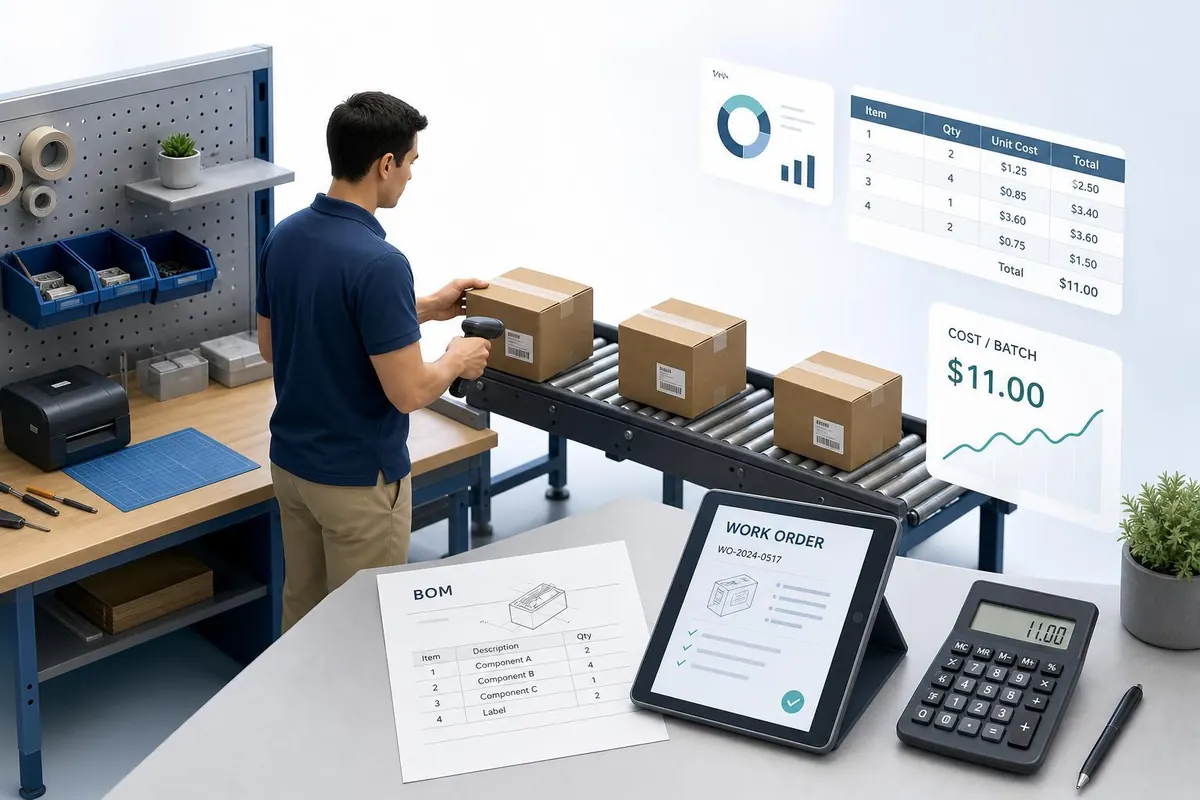
For small light-manufacturing and packaging businesses in British Columbia, understanding the bill of materials (BOM), work orders and how to calculate per-batch costs is essential to profitability, pricing and regulatory compliance. This article walks through practical ways to set up accurate BOMs, design work orders that capture real production data, and roll up materials, labour and overhead into a reliable per-batch cost. Examples use Canadian dollars (CAD) and reflect considerations specific to BC such as GST/PST handling and traceability. By the end you will have a step-by-step approach to reduce surprises from yield loss and waste, choose an inventory costing method that suits your operation, and adopt simple controls and software to keep costs current and defensible.
building an accurate bill of materials
An accurate BOM is the foundation for costing. For light manufacturing and packaging, a BOM should capture the exact materials, quantities, units of measure, substitutions, and expected yield per finished unit or per batch.
- Line items: Include raw ingredients, components, consumables (glue, labels), and packaging (primary and secondary). List unit cost in CAD and supplier lead time.
- Units and yields: Record units (kg, g, L, each) and the expected yield or conversion rate. If 10 kg of mix makes 500 bars, note that conversion to avoid miscounting material needs.
- Scrap and trimming: Add a contingency line for expected waste. For example, if 2% of material is normally lost, include it in the BOM as a separate line item or inflate material quantities accordingly.
- Version control: Put a revision date and approver on the BOM. When a supplier or formulation changes, update the BOM and re-cost the item.
Example BOM (for a small batch of 500 snack bars):
| Item | Qty per batch | Unit | Unit cost (CAD) | Extended (CAD) |
|---|---|---|---|---|
| Base mix | 25 | kg | 6.00 | 150.00 |
| Chocolate coating | 10 | kg | 8.50 | 85.00 |
| Primary wrappers | 500 | each | 0.06 | 30.00 |
| Labels | 500 | each | 0.02 | 10.00 |
| Expected waste | — | — | — | 7.00 |
| Materials total | 282.00 |
designing work orders and capturing actuals
Work orders translate the BOM into production reality. A good work order not only instructs the shop floor, it captures real-time data that feeds cost variance analysis.
- Essential fields: Batch number, start/finish date and time, quantity planned vs produced, BOM revision, operator(s), machine or line, and routing steps.
- Material reservation vs actual usage: Reserve materials at start to ensure availability. Record actual quantities consumed to identify overuse or theft.
- Labor capture: Track operator time on the work order by step (setup, run, pack). For small shops, a simple clock-in/out per job is effective.
- Yield and QC results: Record rejects, rework, and final pass quantity. Include batch-level QC notes (e.g., moisture, weight) for traceability and cost adjustments.
Why capturing actuals matters: if you estimate 25 kg of mix but consume 27 kg, that 2 kg difference converts directly to a material variance that you must either control or account for in pricing.
calculating per-batch cost and allocating overhead
Per-batch cost = direct materials + direct labour + allocated overhead + packaging + freight in + adjustments for waste and yield. The key is consistent allocation and routine variance analysis.
- Direct materials: Use actual consumed quantities multiplied by unit costs in CAD. For regular purchases, record landed cost including freight-in and duties if any.
- Direct labour: Sum operator wages times hours on the work order. Include statutory payroll costs such as CPP and EI approximated at payroll time; for simplicity, add a labour burden percentage (for example 12 to 20%).
- Manufacturing overhead: Allocate utilities, rent, equipment depreciation, maintenance and indirect supplies. Choose a driver — per labour hour, per machine hour, or per batch — that best reflects how costs are consumed.
- Waste and yield adjustment: Convert rejected product into a cost line. If a batch yields 480 saleable units from 500 planned, divide total batch cost by 480 for unit cost.
Sample per-batch cost calculation (continuing the 500 bars example):
| Cost element | Amount (CAD) |
|---|---|
| Materials (from BOM) | 282.00 |
| Direct labour (4 hours @ $25/hr, 15% burden) | 115.00 |
| Packaging and packing labour | 60.00 |
| Allocated overhead (utilities, rent allocation) | 40.00 |
| Quality scrap adjustment | 8.00 |
| Total batch cost | 505.00 |
| Saleable units | 480 |
| Cost per unit | 1.05 |
Note: Cost per unit equals total batch cost divided by saleable units. Record this on the finished goods inventory card and use it for pricing and margin calculations.
closing the loop: control, pricing and software
Once you have BOMs, work orders and costing, use controls and simple tools to keep numbers accurate and actionable.
- Inventory costing method: Choose FIFO, weighted average, or standard cost. For predictable small batches, standard costing simplifies planning. Reconcile variances monthly and update standards if variance persists.
- Software and record keeping: Start with a system that supports BOMs and work orders. Options for small BC businesses include QuickBooks Online with a manufacturing add-on, Katana, or Fishbowl. Even spreadsheets can work if disciplined.
- Tax and regulatory notes: Track GST (5%) charged on sales and input tax credits for GST paid on purchases. PST rules in BC vary by product; consult an accountant for PST treatment of inputs and finished goods. Maintain lot traceability for recalls and food or health-related regulations.
- Actions to reduce cost drift:
- Review BOMs quarterly and after supplier price changes.
- Run variance reports monthly: material usage variance, labour efficiency variance, overhead absorption variance.
- Set target yields and implement simple QC checkpoints to catch issues early.
- Pricing guidance: After cost per unit, add desired gross margin and factor in marketing, shipping to customers, and taxes. Example: with cost per unit $1.05 and target gross margin 60%, price = $1.05 / (1 - 0.60) = $2.63 before taxes.
Conclusion
For small light-manufacturing and packaging businesses in BC, precision in BOMs, disciplined work orders, and transparent overhead allocation are what turn estimates into reliable per-batch costs. Start by building BOMs that include yields and waste, design work orders that capture actuals for material and labour, and choose an overhead allocation rule that reflects your operation. Use monthly variance analysis to find trends and update standards when costs move. Invest in a simple software tool or disciplined spreadsheets, and coordinate with an accountant on GST/PST and payroll burden assumptions. With these practices you will improve pricing accuracy, protect margins, and make better operational decisions.