
Introduction
Artificial intelligence has moved from novelty to utility, and now affects countless small decisions we make each day. Whether from a phone, a car display or a kitchen appliance, AI quietly helps with scheduling, search, security and entertainment. This article examines how AI is used across everyday settings, connecting personal convenience with workplace efficiency and public services. You will see concrete examples of tools people actually use, measurable effects they produce, and practical trade-offs to consider. Rather than a technical survey, the focus is on lived experience: how AI shapes routines, where it amplifies human capacity, and what individuals can do to get benefits while managing risks. The goal is practical clarity for anyone navigating AI in daily life.
Personal assistants and smart homes
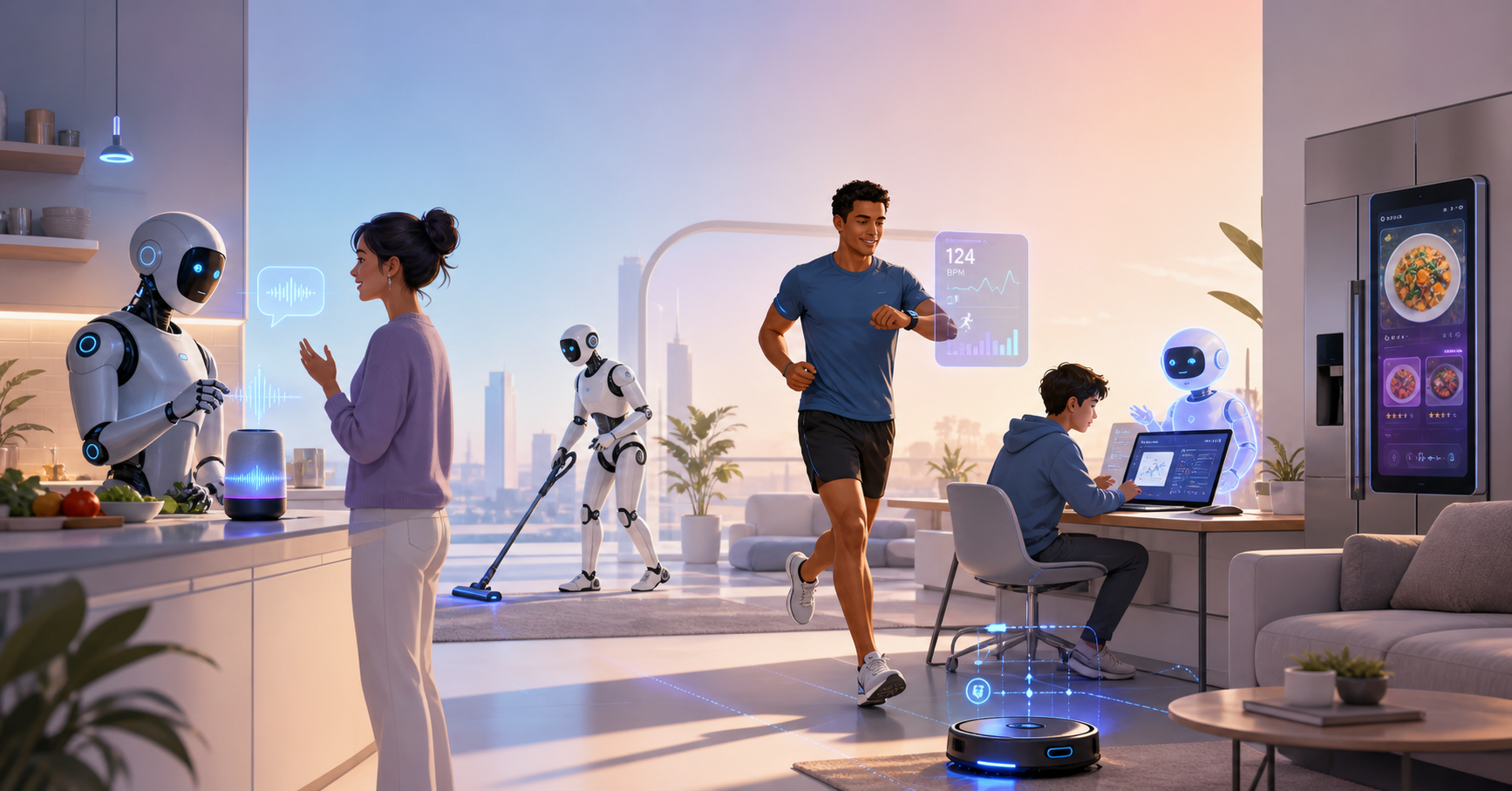
Voice and text assistants, smart thermostats, lighting and appliance automation are the most visible forms of AI in the home. These systems use speech recognition, simple natural language understanding and pattern recognition to anticipate needs. For example, a smart thermostat learns occupancy patterns and adjusts heating to save energy; a voice assistant can set reminders, control streaming and fetch information without interrupting tasks. The immediate benefits are convenience and time savings, but the technology also changes behavior: people rely more on reminders and recommendations, which can increase efficiency but reduce memory practice.
Practical tips for responsible use:
- Limit data collection where possible by reviewing privacy settings.
- Use routines to automate repetitive tasks, but keep manual overrides accessible.
- Segment devices on a separate network to reduce security risk.
Productivity at work and in learning
AI tools for writing, scheduling, data analysis and coding accelerate common workflows. Email triage, calendar scheduling assistants and automated meeting notes save time; intelligent search and summarization help students and professionals extract essential points from long documents. At work, AI can transform raw data into visual insights, suggest next steps and automate recurring tasks. In education, adaptive learning platforms tailor content to a student’s pace, improving retention and identifying gaps earlier than traditional methods.
Integration with the home examples is natural: a voice assistant can act as a bridge, launching learning modules or summarizing a meeting transcript while you make breakfast. To get the most value, pair AI suggestions with human judgment: review and edit generated content, and verify data-driven recommendations against domain knowledge.
Health, mobility and public services
AI features increasingly in health apps, wearable devices and municipal services. Wearables use anomaly detection to flag irregular heart rates or sleep patterns; apps provide medication reminders and symptom checkers. Transportation apps use route optimization and predictive traffic models to reduce commute time. Public services use chatbots for basic queries, freeing staff to handle complex cases. These applications improve access and early detection, but their effectiveness depends on data quality and integration with human professionals.
When interacting with health or civic AI, keep these points in mind:
- Use AI for screening and convenience, but consult professionals for diagnoses and legal matters.
- Check whether local services allow human follow-up if automated answers are insufficient.
- Understand how your data is stored and who can access it.
Ethics, privacy and preparing for change
Everyday AI raises governance and behavior questions: bias in recommendations, privacy trade-offs and deskilling if we over-rely on automation. These concerns tie back to the applications described above. For example, a biased hiring tool can mirror workplace inequities, and a poorly secured home device can expose personal information. Preparing for change means combining awareness with concrete actions: audit permissions, diversify information sources, and develop basic literacy about how models are trained and where errors occur.
Practical preparation steps:
- Regularly review app permissions and delete unused services.
- Keep human-in-the-loop checks for decisions with significant consequences.
- Learn one or two trustworthy AI tools deeply rather than dozens superficially.
Quick reference: everyday AI impacts
| Application | Typical benefit | Estimated time saved per week |
|---|---|---|
| Voice assistants | Hands-free queries, control of devices | 2–5 hours |
| Smart home automation | Energy savings, routine tasks automated | 1–3 hours |
| Productivity tools (summaries, scheduling) | Faster document review, fewer meetings | 4–8 hours |
| Health monitoring apps | Early alerts, improved adherence | 1–2 hours (indirect) |
Conclusion
AI is already woven into daily life through assistants, automation, productivity tools and public-facing services. Across home, work and public contexts the common themes are convenience, time savings and improved access, balanced by privacy, bias and dependency risks. The most effective approach is pragmatic: adopt tools that solve clear problems, keep humans in the decision loop for important outcomes, and practice basic data hygiene. Small steps such as reviewing permissions, using secure networks and verifying AI-generated outputs preserve benefits while reducing harm. Looking ahead, incremental learning and selective adoption will help individuals and communities capture value from AI while staying resilient to change.