
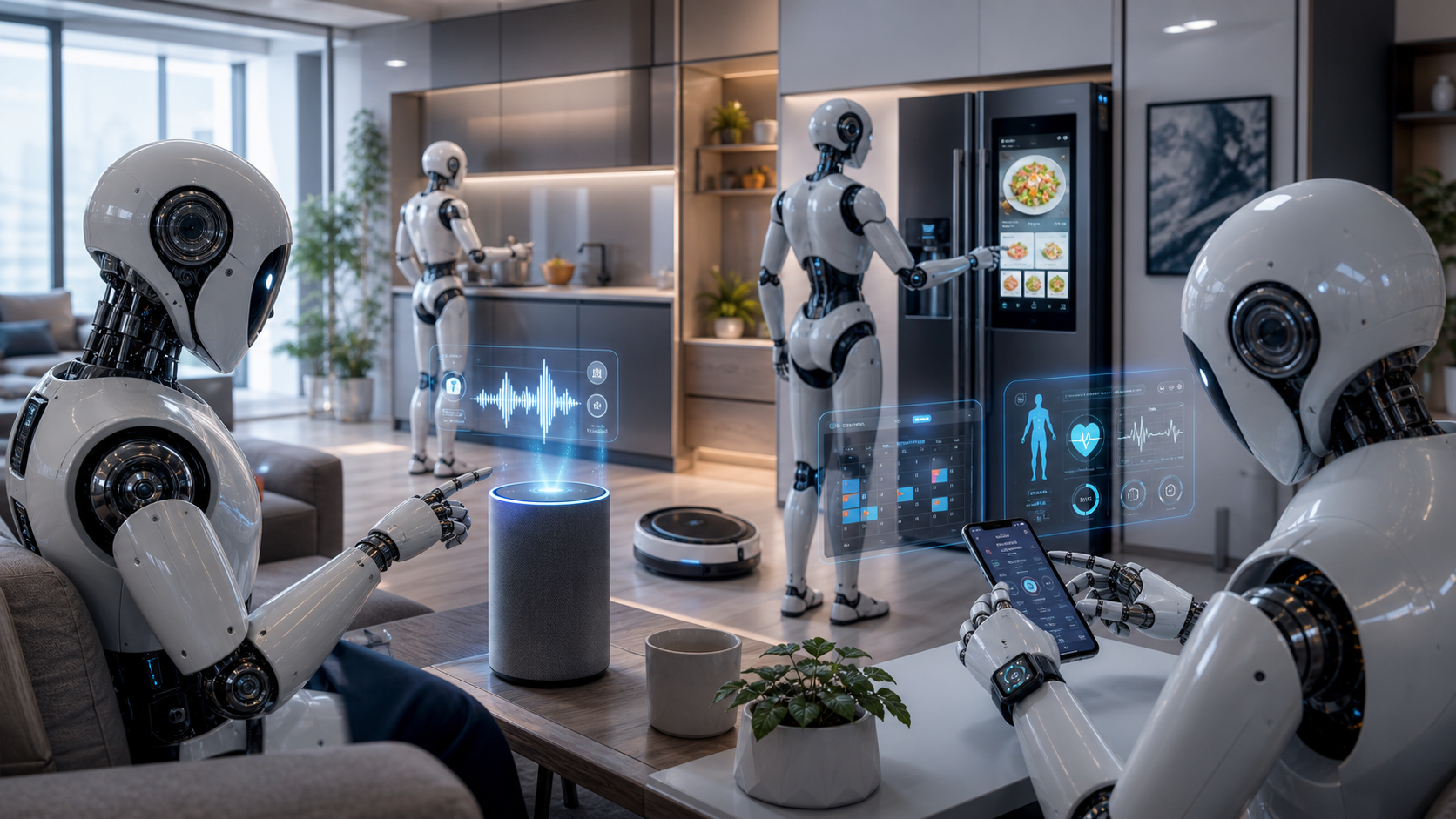
Introduction
Artificial intelligence has shifted from futuristic speculation to an everyday utility that quietly shapes routines, choices, and environments. From voice-activated reminders to algorithms curating newsfeeds and navigation that reroutes based on real-time traffic, AI is woven into how people communicate, work, commute, shop and manage health. This article explores concrete ways AI is used in daily life, showing practical benefits, trade-offs and how these uses connect across contexts. We will look first at personal assistants and devices, then at smart living and mobility, next at workplace productivity, and health tools, before closing with responsible adoption and future directions. The aim is to give practical insight and actionable understanding for readers who want to use AI more deliberately.
Everyday personal assistants
Most people’s first interaction with AI is through personal devices. Smartphones and smart speakers use natural language processing to interpret commands, set reminders, send messages and control other devices. Beyond simple commands, recommendation engines personalize content across music, video and shopping apps by learning preferences and context.
Key capabilities and practical tips:
- Voice interaction: Use concise prompts and follow-up corrections to train accuracy; link devices to calendars and contacts for better results.
- Personalization: Curate recommendations by rating content and clearing irrelevant history to improve future suggestions.
- Privacy settings: Adjust data-sharing options on apps to balance convenience with control over personal data.
Smart home and mobility
AI turns homes and travel into responsive systems. Thermostats learn occupancy patterns to optimize comfort and energy use. Security cameras use motion detection and object recognition to reduce false alarms. In transportation, navigation apps combine map data, traffic sensors and user reports to choose faster routes and suggest departure times.
Practical considerations:
- Integrate devices on a single platform when possible – this reduces friction and creates stronger automation scenarios.
- Monitor energy and usage dashboards to find automation rules that save cost without sacrificing comfort.
- When using mobility apps, compare estimated arrival times and congestion forecasts rather than relying on a single source.
Work and productivity
AI augmentations at work accelerate routine tasks and surface insights from data. Email filtering and drafting aids reduce inbox noise and speed composition. Automation platforms handle repetitive workflows – data entry, approvals and report generation – freeing time for higher-value work. In knowledge work, search engines enhanced by AI summarize documents and suggest relevant resources.
Adoption tips and impact:
- Start by automating one repetitive process and measure time saved before scaling automation.
- Use AI-powered summarization to prepare meeting briefs and action items; verify key facts before sharing.
- Train teams on prompt design and review cycles to avoid overreliance on imperfect outputs.
Health and well-being
AI is increasingly integrated into personal health tools. Wearables analyze activity, sleep and heart metrics to suggest actionable changes. Telehealth platforms use symptom checkers and triage algorithms to prioritize care. On a broader scale, AI assists clinicians with image analysis and treatment recommendations, improving early detection for some conditions.
How to use these tools effectively:
- Treat AI-generated health suggestions as guidance, not definitive diagnosis; consult professionals for medical decisions.
- Combine continuous metrics (sleep, activity) with periodic medical checkups for a fuller picture of health.
- Verify device accuracy and data-sharing policies before linking medical records or sensitive data.
Responsible adoption and future trends
Real benefits of AI depend on thoughtful adoption. That means understanding limitations, guarding privacy and designing fallback plans when systems err. As models improve, expect more seamless context-aware experiences – for example, personal assistants that proactively assemble summaries from multiple apps, or homes that balance comfort with micro-grid energy trading.
Practical governance steps:
- Keep an inventory of AI tools you use and the data they collect.
- Regularly review permissions, and revoke access for unused apps.
- Promote digital literacy – teach basic evaluation of AI outputs among family and colleagues.
Representative AI use and estimated impact
| Domain | Common features | Estimated weekly time saved (typical user) |
|---|---|---|
| Personal assistants | Voice commands, reminders, recommendations | 1 – 3 hours |
| Smart home | Thermostat optimization, security alerts | 0.5 – 2 hours (reduced chores) |
| Work productivity | Email triage, document summarization, automation | 2 – 8 hours |
| Health monitoring | Activity tracking, symptom triage | 0.5 – 1.5 hours (better decision time) |
Conclusion
AI in daily life is practical, pervasive and evolving. Personal assistants make routine tasks faster, smart homes and mobility systems increase comfort and efficiency, workplace tools free time for creative work, and health technologies support better self-care and earlier intervention. Across these areas the pattern is similar – AI absorbs repetitive tasks, surfaces relevant information, and adapts to user behavior. The net benefit depends on using tools with clear intent, safeguarding privacy and maintaining human oversight. By inventorying tools, setting permissions thoughtfully and educating users, people can maximize convenience while limiting risks. Looking ahead, steady improvements will expand usefulness, but the human role in governance and judgment remains essential.