
Introduction
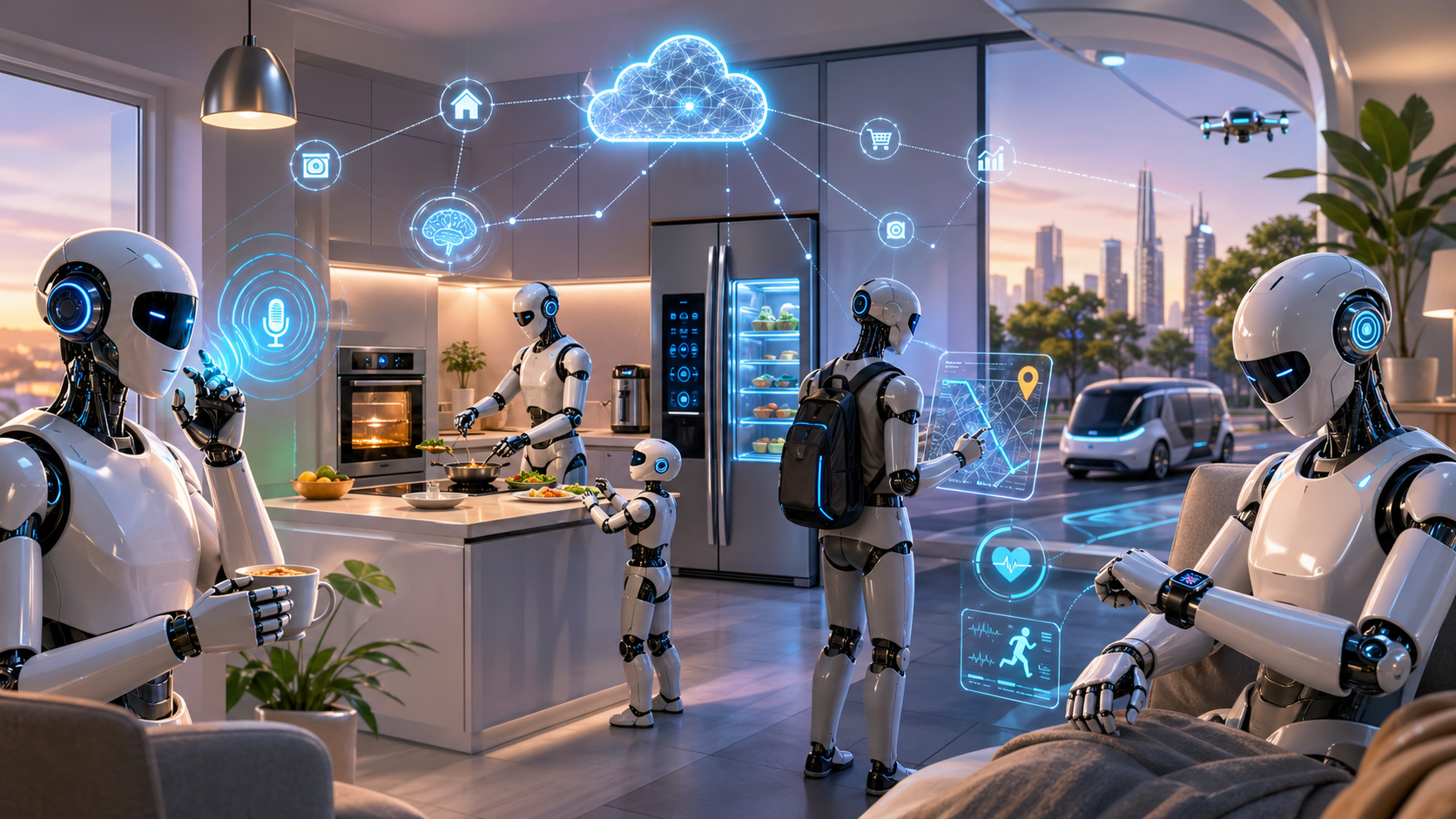
Artificial intelligence has moved from science fiction into the background of everyday routines, quietly shaping how we communicate, travel, work and stay healthy. This article examines practical AI uses people encounter daily, from voice assistants and smart thermostats to personalized health monitoring and tools that transform learning and creativity. Rather than presenting abstract theory, the focus is on concrete applications, measurable benefits and simple steps to use AI responsibly. You will see how small automation choices compound into meaningful time savings, why interoperability matters when devices share data, and what to watch for in terms of privacy and bias. The following chapters flow from individual tools to household systems, then to wellbeing, professional life and finally pragmatic guidance for safe adoption.
Personal assistants and productivity
AI-powered personal assistants and productivity tools are the most visible entry points for many users. Voice assistants, email filters, calendar planners and smart search engines reduce friction in routine tasks. For example, natural language processing lets you dictate messages, summarize long threads, or ask for prioritized to-do lists. Machine learning models infer patterns in your behavior to suggest ideal meeting times or automate repetitive responses.
These systems increase productivity in three main ways: time savings, improved focus, and decision support. Time savings come from automating low-value tasks. Improved focus results when notifications are filtered and summarized. Decision support appears as contextual suggestions, such as alternative phrasing for a message or an action plan after a meeting. To get the most value, pair automation with clear personal rules so the assistant makes choices aligned with your priorities.
Smart home and mobility
Once AI lives in personal tools, it naturally expands into shared environments. Smart home devices, connected appliances and navigation apps use sensor data and predictive models to optimize comfort, safety and travel time. Thermostats learn occupancy patterns to reduce energy waste. Cameras and doorbells apply object recognition to flag visitors. In mobility, route planning combines live traffic, historical patterns and user preferences to recommend departures and lanes.
Interconnection is where benefits multiply: when a calendar, commute app and smart thermostat share minimal, consented signals, the house can heat up before you arrive only on days you will be home. That requires thoughtful configuration and secure integrations. Below is a compact table showing typical domains, common uses and expected impact ranges to help you decide priorities.
| Domain | Common AI uses | Typical impact |
|---|---|---|
| Personal productivity | Summaries, scheduling, email triage | Minutes saved per day: 20 to 60 |
| Smart home | Energy management, security alerts | Energy reduction: 5 to 20 percent |
| Mobility | Route optimization, multimodal planning | Commute time reduction: 10 to 30 percent |
| Health and wellness | Activity tracking, sleep coaching, symptom checkers | Behavioral adherence improvements: 10 to 40 percent |
Health and wellness
AI in daily health routines blends passive monitoring with active guidance. Wearables and apps analyze heart rate variability, sleep phases and activity patterns to produce actionable insights like personalized exercise intensity or sleep hygiene tips. Symptom checkers and medication reminders reduce missed doses and provide early flags when conditions deviate from expected baselines.
Clinical-grade AI applications also assist clinicians with diagnostics and triage, but the consumer-facing side focuses on prevention and behavior change. The key limitation is data quality: models perform best with consistent, accurate inputs. Users should view AI suggestions as supplementary, not a replacement for professional medical advice. Integrating AI outputs into conversations with clinicians improves care continuity and makes recommendations more practical.
Work, education and ethical adoption
AI reshapes how we work and learn by automating routine tasks, enabling adaptive instruction and augmenting creativity. In the workplace, tools generate first drafts, extract insights from documents and automate reporting. In education, adaptive learning platforms adjust pace and content to each student, improving engagement and outcomes when combined with human coaching.
Adoption must confront ethical issues: privacy, algorithmic bias and transparency. Practical steps include limiting data sharing to what is necessary, reviewing model outputs critically, and preferring vendors that publish explainability and audit practices. Organizations should provide basic literacy training so employees and students can interpret AI suggestions, challenge mistakes and use systems as partners rather than unquestioned authorities.
Finally, accessibility and inclusion matter. When designers include diverse data and user testing, AI tools serve broader populations and reduce inadvertent exclusion.
Conclusion
AI is already woven into daily life through assistants, home systems, health tools and workplace platforms. The most immediate benefits are time savings, better focus and more personalized services, while compounded advantages arise when devices and services share minimal, consented context. However, practical adoption requires attention to data quality, privacy and bias. Start small: automate a few repetitive tasks, secure integrations, and verify outputs with human judgment. In health and education, treat AI as an enhancer rather than a replacement for professionals. When organizations and individuals combine thoughtful configuration, basic literacy and transparent vendors, AI becomes a reliable productivity and wellbeing partner rather than a source of risk. Embrace it pragmatically, and prioritize control, consent and continuous evaluation.